


Documentation [Víctor Rodríguez Martínez]
PLEASE NOTE
1) In order to be able to consult the Positio please fill in the request form on this page.
2) If your request is accepted, we will then send you the conditions and directions for consulting the document.
Procedure - Víctor Rodríguez Martínez
1. The canonical norms concerning the procedure to be followed in the Causes of Saints are stated in the Apostolic Constitution Divinus Perfectionis Magister promulgated by John Paul II on 25 January 1983 (AAS LXXV, 1983, 349-355).
2. To initiate a Cause it is necessary that at least five years pass after the death of the candidate. This is to allow for greater balance and objectivity in the evaluation of the case and to allow the emotions of the moment to decant. There must be a clear conviction among people about his/her sanctity (fama sanctitas) and about the efficacy of his/her intercession with the Lord (fama signorum).
Links - Mercedes di Santa Teresina
Procedure - Mercedes di Santa Teresina
1. The canonical norms concerning the procedure to be followed in the Causes of Saints are stated in the Apostolic Constitution Divinus Perfectionis Magister promulgated by John Paul II on 25 January 1983 (AAS LXXV, 1983, 349-355).
2. To initiate a Cause it is necessary that at least five years pass after the death of the candidate. This is to allow for greater balance and objectivity in the evaluation of the case and to allow the emotions of the moment to decant. There must be a clear conviction among people about his/her sanctity (fama sanctitas) and about the efficacy of his/her intercession with the Lord (fama signorum).
Documentation [Mercedes di Santa Teresina]
PLEASE NOTE
1) In order to be able to consult the Positio please fill in the request form on this page.
2) If your request is accepted, we will then send you the conditions and directions for consulting the document.
[No form id or name provided!]
Mercedes di Santa Teresina

Mercedes was born in Tunja (Boyacá), Colombia, on November 18, 1930.
At the age of 22 she entered the Monastery of the Discalced Carmelite nuns of Villa de Leyva, receiving the name of Mary Celine of Saint Therese, returning in 1979 to her baptismal name.
Her intense spiritual life led her to make a vow to do always her best. Endowed with special human gifts, the sisters of her community chose her as Prioress, a service she held for 24 years. In 2007 she went to Garagoa (Boyacá) to found a new monastery of Discalced Carmelite nuns.
She died in this city on May 19, 2012.
On December 12th, 2019, the Garagoa diocesan Inquiry on her «life, virtue and reputation for holiness» began.
Links - Aloisio Maria Benziger (vescovo)

Documentation [Aloisio Maria Benziger - vescovo]
PLEASE NOTE
1) In order to be able to consult the Positio please fill in the request form on this page.
2) If your request is accepted, we will then send you the conditions and directions for consulting the document.
[No form id or name provided!]
Procedure - Aloisio Maria Benziger (vescovo)
1. The canonical norms concerning the procedure to be followed in the Causes of Saints are stated in the Apostolic Constitution Divinus Perfectionis Magister promulgated by John Paul II on 25 January 1983 (AAS LXXV, 1983, 349-355).
2. To initiate a Cause it is necessary that at least five years pass after the death of the candidate. This is to allow for greater balance and objectivity in the evaluation of the case and to allow the emotions of the moment to decant. There must be a clear conviction among people about his/her sanctity (fama sanctitas) and about the efficacy of his/her intercession with the Lord (fama signorum).
Aloisio Maria Benziger (vescovo)
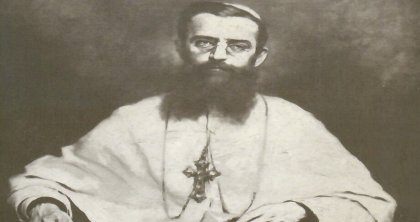
Aloysius Benziger was born in Einsiedeln, Switzerland, on 31st of January 1864 as the fourth child and second son of Johannes Adelrich Benziger and Anna Maria Koch von Boswayal.
The Benziger family belonged to the nobility and were the publishers for the Holy See. In addition, the family was deeply faithful to the Catholic faith.
The boy received a diverse, liberal education. After the sudden death of his older brother, his father thought of making Aloysius his successor in the publishing trade. But the young man had no ambition in this matter. He wanted to become a priest. His father organized a course in Paris for the study of French; he was sent to England to study English. He studied philosophy and theology at the University of Eichstatt, Germany.
He joined the Carmelite novitiate in Bruges on May 26, 1884 taking the name of Aloysius of St. Mary. He made his temporary vows on May 28, 1885. His stay in the novitiate gave him the opportunity to be in contact with Fr. Alphonsus of Our Lady of Sorrows, who was once a missionary in India. He made his solemn profession on May 28, 1888. He was ordained a priest on 22nd of December 1888 by the auxiliary bishop of Ghent, Archbishop H. Lambrechts.
After his ordination, he wrote repeatedly to the Father General of the Discalced Carmelite Order expressing his desire to go on a mission. Seeing the firm will of Fr. Aloysius, the Father General granted him permission and the Congregation of Propaganda issued the missionary patent for him. He left the monastery of Ghent on 28 August 1890 and reached India on the 9th of October 1890.
The first task that Fr Aloysius received on his arrival in India was that of professor of English, Latin, dogmatic theology and sacred scripture in the seminary of Puthenpally. He also served as spiritual director of the seminarians. Archbishop Władysław Zaleski, Apostolic Delegate for the East Indies, paid a visit to the seminary in 1892. He was impressed by the prayerful attitude and exemplary life of Father Aloysius. With permission from the superiors, he appointed him his private secretary.
While still private secretary of the Apostolic Delegate, he was elected as coadjutor of the bishop of Quilon. Aloysius received episcopal ordination in Kandy on November 18, 1900. His motto was: per crucem (through the cross). Immediately after his consecration he was appointed Vicar General of the Diocese of Quilon. The Bishop of Quilon died in Ghent on August 14, 1905. Bishop Aloysius, who was coadjutor, took office in the diocese of Quilon on September 14, 1905. He ruled the diocese for 31 years, five years as Coadjutor and 26 years as Bishop.
He was a missionary pastor, a mendicant bishop who went in search of financial aid for his missionary work. He was a diligent promoter of meetings. He played a significant role in the return of Archbishop Mar Ivanios and his companion to the Catholic Church and the formation of the Syro-Malabar rite. Tired and ill, he resigned from his office on August 10, 1931 and retired to the monastery of Carmel Hill, Trivandrum. In 1931, he was appointed Titular Archbishop of Antinoe.
At Carmel Hill he lived a life of solitude and prayer. He went out only to hear the confessions of some religious communities. Long journeys were very few: in the absence of the bishop of Quilon, he had to go to his old see to bless the holy oils; in 1937, he went again to consecrate his successor. His last trip abroad was in 1938 to Europe, to accompany and introduce Archbishop V. Dereira, his successor, to members of his family and some other benefactors.
On March 25, 1942, while celebrating Holy Mass in the chapel of the novitiate, he fell while at the altar. His last days were days of intense suffering. On August 16, he received the last sacraments from Archbishop Vincent Dereira, his successor at Trivandrum.
On August 17, he returned to the Father's house.
On August 17, 2017, the Diocesan Inquiry into his "life, virtue and reputation for holiness" began.
Last News

Servant of God Maria Angelica of the Eucharist
June 25, 2026

Venerable Jean-Thierry of the Child Jesus and the …
June 17, 2026

Venerable Maria Eletta di Gesù
June 17, 2026

Venerable Maria Teresa of the Most Holy Trinity (Y…
June 17, 2026

Blessed Anna of Saint Bartholomew
June 10, 2026

Martyrs of Santander
May 27, 2026