


Maria Candida dell’Eucarestia

Maria Barba was born on 16 January 1884 into the bosom of a deeply believing family, but which resolutely opposed her religious vocation, manifested since the age of fifteen.
Maria, in fact, would have to wait almost twenty years before she could effectively realize her aspiration, demonstrating, in these years of expectation and interior suffering, a surprising fortitude of soul and an uncommon fidelity to the initial inspiration. In this struggle, which ended with her entry into the Teresian Carmel in Ragusa on 25th of September 1919, Maria Barba was sustained by a very special devotion to the mystery of the Eucharist: in the Eucharist, she saw the mystery of God's sacramental presence in the world, the concreteness of his infinite love for people, the reason for our full trust in his promises.
Upon entering Carmel, where she took the name of Mary Candida of the Eucharist, she fully developed what she herself called her «vocation for the Eucharist».
Elected prioress of the monastery in 1924, she remained so until 1947, except for a brief interruption, instilling in her community a deep love for the Rule of Saint Teresa of Jesus and contributing directly to the expansion of the Teresian Carmel in Sicily, and to the return of the male branch of the Order.
The Lord called her, after a few months of acute physical suffering, on June 12, 1949, on the Solemnity of the Most Holy Trinity.
The beatification ceremony took place on March 21, 2004.
Documentation [Maria Candida dell’Eucarestia]
PLEASE NOTE
1) In order to be able to consult the Positio please fill in the request form on this page.
2) If your request is accepted, we will then send you the conditions and directions for consulting the document.
Links - Maria Candida dell’Eucarestia

Procedure - Maria Candida dell’Eucarestia
1. The canonical norms concerning the procedure to be followed in the Causes of Saints are stated in the Apostolic Constitution Divinus Perfectionis Magister promulgated by John Paul II on 25 January 1983 (AAS LXXV, 1983, 349-355).
2. To initiate a Cause it is necessary that at least five years pass after the death of the candidate. This is to allow for greater balance and objectivity in the evaluation of the case and to allow the emotions of the moment to decant. There must be a clear conviction among people about his/her sanctity (fama sanctitas) and about the efficacy of his/her intercession with the Lord (fama signorum).
Giuseppa Naval Girbes

Maria Josefa was born on December 11, 1820, 32 kilometres from Valencia. She was the eldest of five children of Francisco Naval and Josefa Maria Girbés. At the age of eight she received the sacrament of Confirmation and at nine made her First Communion. Since there was no public school she was able, only for a short time, to attend one managed by the Chapter of the Cathedral of Valencia, where she learned embroidery very well and to read a little, but not to write.
On June 13, 1833, her mother died and, having left school, she had to take care of her father and siblings, welcomed by her uncle Joaquín and grandmother Vicenta. Faith and piety grew with age and at 18 she made a vow of perpetual chastity. On July 27, her grandmother also died and therefore she had to take over the leadership of the house and take care of her father, uncle and brothers.
She became a member of the Fraternity of the Secular Order of the Discalced Carmelites in the Valencia monastery. Great was her love for Our Lady of Mt Carmel, St. Teresa of Jesus and St. John of the Cross. Her spiritual life grew in the warmth of the doctrine and experience of the Carmelite Saints and became a demonstration of how holiness could develop in every state of life, including the secular state.
In 1850, now mature in the life of prayer and in the practice of virtue, she felt an inner urge to offer others the riches of her soul. With the permission of the parish priest, she began to gather her friends for readings, conversations and spiritual insights. She taught the art of embroidery to the girls of the city for free and so her house becomes a laboratory and a school of spirituality. Catechism was taught, children were prepared for First Communion, there was collaboration in parish initiatives and young people were introduced to marriage or religious life. Above all, there was practice of meditation, the exercise of union with God and active participation in the liturgical life and social initiatives of the parish.
In 1877, with some friends, she deepened her initiatives, planning days of retreat in a country house. In 1891, her always precarious health began to deteriorate due to some heart ailments. She died on February 24, 1893. She was buried with the Carmelite habit, as she had expressly requested during her lifetime.
The beatification ceremony took place on September 25, 1988.
Documentation [Giuseppa Naval Girbes]
PLEASE NOTE
1) In order to be able to consult the Positio please fill in the request form on this page.
2) If your request is accepted, we will then send you the conditions and directions for consulting the document.
[No form id or name provided!]
Links - Giuseppa Naval Girbes
Procedure - Giuseppa Naval Girbes
1. The canonical norms concerning the procedure to be followed in the Causes of Saints are stated in the Apostolic Constitution Divinus Perfectionis Magister promulgated by John Paul II on 25 January 1983 (AAS LXXV, 1983, 349-355).
2. To initiate a Cause it is necessary that at least five years pass after the death of the candidate. This is to allow for greater balance and objectivity in the evaluation of the case and to allow the emotions of the moment to decant. There must be a clear conviction among people about his/her sanctity (fama sanctitas) and about the efficacy of his/her intercession with the Lord (fama signorum).
Eufrasio di Gesù Bambino
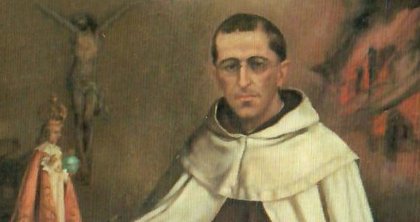
Eufrasio was born in Cancienes (Spain) on February 8, 1897 and was baptized the following day. He spent his infancy and childhood under the tutelage of his grandfather Vincenzo in La Cuesta.
After a brief stay with the Brothers of the Christian Schools (1911), on 5th of December 1912 he was at the Teresian College of Villafranca (Navarre). After completing his formation in Larrea (Vizcaya), on 26th of July 1916 he made his religious profession; followed by the years of theological and philosophical studies, in different Carmelite colleges (Marquina, Burgos, Vitoria and Bilbao), towards the goal of priesthood.
Eufrasio was ordained in Santander on September 23, 1922; on October 1st he celebrated his first Mass in Oviedo. Appointed professor of philosophy and theology in various colleges, at the same time he dedicated himself to a fruitful priestly ministry.
On September 5, 1926, his superiors sent him to Krakow (Poland) to strengthen the presence of Carmel in the countries of Eastern Europe; a land that he loved deeply, learning above all the difficult Slavic language in order to exercise his apostolate.
Recalled to Burgos in the autumn of 1928, he contributed to the magazines «Il Monte Carmelo» and «Eco del Carmelo e Praga»; in July 1929 he was a professor in Oviedo. This was the last stage of his earthly life in which he would bear witness to Christ by martyrdom. From 1929 to 1934 he supervised and directed the catechetical meetings held in the monastery, much appreciated by the many participants. Elected prior in May 1933, days followed in which the community sensed the painful times that the atheist revolution was preparing in Asturias (October 1933).
In those tragic times, Fr. Eufrasio did not abandon his confreres until all were rescued. He himself was about to leave, when he had to seek treatment at the hospital in Oviedo for a hip dislocation that prevented him from walking. Recognized as a religious, indeed as «the prior of the Carmelites», as he himself declared, on October 12, 1934 he was shot near the wall of the «Old Market». Addressing those who were about to kill him as «my children,» he forgave them.
The decree on martyrdom was promulgated on December 16, 2006. The beatification ceremony took place on October 28, 2007.
Documentation [Eufrasio di Gesù Bambino]
PLEASE NOTE
1) In order to be able to consult the Positio please fill in the request form on this page.
2) If your request is accepted, we will then send you the conditions and directions for consulting the document.
[No form id or name provided!]
Last News

Servant of God Maria Angelica of the Eucharist
June 25, 2026

Venerable Jean-Thierry of the Child Jesus and the …
June 17, 2026

Venerable Maria Eletta di Gesù
June 17, 2026

Venerable Maria Teresa of the Most Holy Trinity (Y…
June 17, 2026

Blessed Anna of Saint Bartholomew
June 10, 2026

Martyrs of Santander
May 27, 2026