


Documentation [Maria Teresa di San Giuseppe (Kierocińska)]
PLEASE NOTE
1) In order to be able to consult the Positio please fill in the request form on this page.
2) If your request is accepted, we will then send you the conditions and directions for consulting the document.
Links - Maria Teresa di San Giuseppe (Kierocińska)

Maria degli Angeli (Operti)
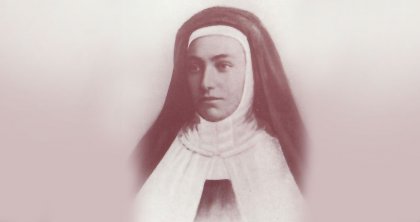
Giuseppina Operti was born in Turin (Italy) on November 16, 1871 into a wealthy family.
She was tested by the death of her brother and father within three months. Together with her mother, she gave herself to a more intense Christian life, also joining the Carmelite Third Order. When she learned from the parish priest of Marene, a town where her family had some possessions, that the rumour was circulating that she would found an institute for poor girls, she took it as a sign of God's will for her: in 1894, in the palace inherited from relatives she inaugurated the Saint Joseph Institute.
Urged by the Archbishop of Turin, Monsignor Davide Riccardi, she began a religious community of Carmelite Tertiaries, who lived the active apostolate of the spirituality of the great reformers of Carmel:
On March 19, 1895, with her religious profession, she changed her name to Sister Mary of the Angels, in honour of the Carmelite Blessed of the same name. Her yearning for cloistered life seemed satisfied when she then entered Carmelite monastery of Moncalieri, but she had to leave for health reasons.
She led the Institute of Tertiaries (which since March 14, 1970 bears the name of Carmelite Sisters of St. Teresa of Turin) in the formation of two branches: a contemplative one, later housed in the new monastery of Cascine Vica, and one of active life, but centred on contemplation.
She spent her last years in the monastery of Cascine Vica, where she died on October 7, 1949.
The decree on her heroic virtue was promulgated on June 16, 2017.
Documentation [Maria degli Angeli (Operti)]
PLEASE NOTE
1) In order to be able to consult the Positio please fill in the request form on this page.
2) If your request is accepted, we will then send you the conditions and directions for consulting the document.
[No form id or name provided!]
Links - Maria degli Angeli (Operti)
Procedure - Maria degli Angeli (Operti)
1. The canonical norms concerning the procedure to be followed in the Causes of Saints are stated in the Apostolic Constitution Divinus Perfectionis Magister promulgated by John Paul II on 25 January 1983 (AAS LXXV, 1983, 349-355).
2. To initiate a Cause it is necessary that at least five years pass after the death of the candidate. This is to allow for greater balance and objectivity in the evaluation of the case and to allow the emotions of the moment to decant. There must be a clear conviction among people about his/her sanctity (fama sanctitas) and about the efficacy of his/her intercession with the Lord (fama signorum).
Maria Veronica della Passione
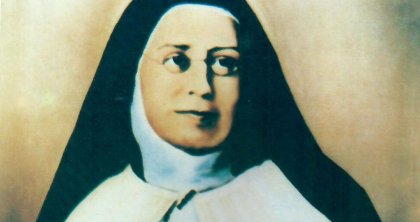
Sophie Leeves was born in Constantinople (now Istanbul) on October 1st, 1823. Her father was the Anglican chaplain of the British Embassy.
During adolescence a profound change took place in her. She spent many hours in prayer and felt drawn to God, without understanding exactly where she was being taken and what she herself wanted.
She felt attracted to the Catholic Church, especially to sacramental life: the Eucharist and confession. Her mother and other family members, deeply rooted in the Anglican tradition, were annoyed by this novelty. But Sophie knew God was leading her into unknown paths. She broke off the engagement she had accepted with a good-looking young naval officer and converted to Catholicism on 2nd of February 1850 in Malta.
Shortly afterwards she went to France (1851) and entered the Congregation of the Sisters of St. Joseph of the Apparition. On September 14, 1851, she took the religious name of Sister Maria Veronica of the Passion. In the new congregation she was to have the position of mistress of novices for some years.
In 1862 she was sent to India. The Bishop of South Kanara Mgr. Michael Antony OCD had appealed to France to send young nuns for the education of girls, and as a first step he had purchased a house in Calicut in 1860 and made the necessary changes until it became a convent. At the request of the local population, the school was opened on April 1st, 1862, under the name of St. Joseph's School.
Mother Veronica and Sister Mary Josephine after a long and tiring journey, and a brief stop in Mangalore, arrived in Calicut on April 27, 1862, took charge of the Convent of St. Joseph and the school, and Mother Veronica became superior. She spent two years in Mangalore and Kozhikode (Calicut).
However, the Bishop of Mangalore, Lucien Garrelon – a French Carmelite Father – wished to have Carmelite nuns for the education of the girls in his diocese. Always attracted to the contemplative life, Mother Veronica accepted the challenge. To prepare for this task she left for France and entered the cloistered novitiate of the Carmel in Pau on July 2nd, 1867.
After a year of formation she opened, on July 16, 1868, a house in Bayonne (France) with the aim of preparing a group of young sisters for the Carmelite Third Order Regular or otherwise called Carmel for the missions. It was at this time that the expression Apostolic Carmel began to be used in her correspondence. Through the Sisters she trained in Bayonne she founded the Apostolic Carmel in Mangalore (Karnataka) in 1868.
Due to profound differences of views with the bishop of Mangalore, partly caused by the presence of the young Arab mystic, Mariam Baouardy, among the Carmelites, several sisters had to return to France.
Displeased with the decision taken by the bishop of Mangalore, the bishop of Bayonne denied other nuns permission to leave for India. As a result, the Carmelite formation house in Bayonne was closed (October 11, 1873) and Mother Veronica returned to the Carmel of Pau, where she again did the novitiate. She was 51 years old when she made her solemn profession as a cloistered Carmelite (November 21, 1874).
When the Carmel of Pau received the request to open a house in the Holy Land, Mother Superior entrusted Mother Veronica with the responsibility of a group of 10 Carmelite Sisters (including Mariam Baouardy) to give life to the Carmel of Bethlehem (August 20, 1875). The Carmel of Bethlehem had adopted the stricter version of the Carmelite Rule. Spiritually, Mother Veronica went through dark times, had scruples and felt abandoned by God. In 1887 – at the age of 67 – she asked and obtained permission to return to Pau.
Mother Veronica lived another 19 years in the Carmel of Pau. She kept in touch with the sisters of the Apostolic Carmel of Mangalore, encouraged them in difficulties, and wrote the history of the beginnings of the Apostolic Carmel. She also prepared a brief biography of the young Arab Carmelite nun (1903) whom she had guided and known very well.
In the last years of her life came some consolations. Her family became closer: although they remained staunchly Anglican, they visited her in Pau, including a young cousin who had become an Anglican pastor.
She died in the Carmel of Pau on November 16, 1906, at the age of 83, much loved and esteemed by the sisters of Carmel, both those of the cloister, and those of the Apostolic Carmel.
The decree on her heroic virtue was promulgated on July 8, 2014.
Documentation [Maria Veronica della Passione]
PLEASE NOTE
1) In order to be able to consult the Positio please fill in the request form on this page.
2) If your request is accepted, we will then send you the conditions and directions for consulting the document.
[No form id or name provided!]
Links - Maria Veronica della Passione
Procedure - Maria Veronica della Passione
1. The canonical norms concerning the procedure to be followed in the Causes of Saints are stated in the Apostolic Constitution Divinus Perfectionis Magister promulgated by John Paul II on 25 January 1983 (AAS LXXV, 1983, 349-355).
2. To initiate a Cause it is necessary that at least five years pass after the death of the candidate. This is to allow for greater balance and objectivity in the evaluation of the case and to allow the emotions of the moment to decant. There must be a clear conviction among people about his/her sanctity (fama sanctitas) and about the efficacy of his/her intercession with the Lord (fama signorum).
Last News

Servant of God Maria Angelica of the Eucharist
June 25, 2026

Venerable Jean-Thierry of the Child Jesus and the …
June 17, 2026

Venerable Maria Eletta di Gesù
June 17, 2026

Venerable Maria Teresa of the Most Holy Trinity (Y…
June 17, 2026

Blessed Anna of Saint Bartholomew
June 10, 2026

Martyrs of Santander
May 27, 2026