


Colomba di Gesù Ostia
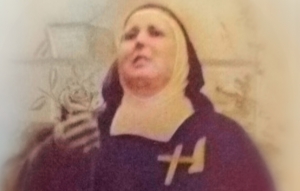
The Servant of God, Colomba of Jesus in the Host (Anna Antonietta Mezzacapo) was born in Marcianise (Caserta, Italy) on June 15, 1914. Raised in a Christian family environment and taking part in parish life, she began her spiritual life journey of under the guidance of the parish priest and, at the same time, after elementary school, she made herself available to help her parents with household chores and in their hardware and food stores. In 1932, she entered the cloistered monastery of the Discalced Carmelite nuns of Marcianise where, in the following years, two of her sisters followed her.
The Servant of God made her first profession on the 6th of June 1934 and her solemn profession on the 24th of November 1938. Appointed Mistress of Novices in 1945, she was elected Prioress in 1951 and confirmed for another four successive three-year terms. In this period she dedicated herself to the spiritual formation of the sisters and to carrying out renovations of the monastery.
In 1961, due to relational problems between a novice and some sisters, the Holy See proceeded to an apostolic visitation, made in 1962 by Fr. Agostino Rosati, O.S.S.T., and ended with the recognition of the full innocence of the Servant of God, who was confirmed in her office as Prioress. In 1965, another canonical visit was made by the Archbishop of Capua, Monsignor Tommaso Leonetti, caused by new accusations by some sisters. In all these trials, Mother Columba remained serene, with the ability to forgive everyone. The Servant of God continued to serve the community with great humility, carrying out her apostolate in the parlour.
In 1968 she was elected Prioress again but, falling ill at the end of the same year, she underwent a delicate surgical operation in January 1969.
She died in Marcianise (Italy) on August 13, 1969.
The decree on her heroic virtue was promulgated on May 22, 2021.
Procedure - Colomba di Gesù Ostia
1. The canonical norms concerning the procedure to be followed in the Causes of Saints are stated in the Apostolic Constitution Divinus Perfectionis Magister promulgated by John Paul II on 25 January 1983 (AAS LXXV, 1983, 349-355).
2. To initiate a Cause it is necessary that at least five years pass after the death of the candidate. This is to allow for greater balance and objectivity in the evaluation of the case and to allow the emotions of the moment to decant. There must be a clear conviction among people about his/her sanctity (fama sanctitas) and about the efficacy of his/her intercession with the Lord (fama signorum).
Documentation [Colomba di Gesù Ostia]
PLEASE NOTE
1) In order to be able to consult the Positio please fill in the request form on this page.
2) If your request is accepted, we will then send you the conditions and directions for consulting the document.
Links - Colomba di Gesù Ostia

Rosa di San Giuseppe
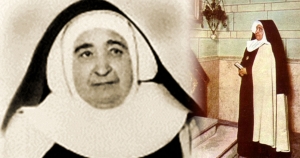
Rosa Ojeda y Creus was born in Vilanova i la Geltrú on August 30, 1871 into a poor family. In 1877, following the death of her parents, she and her two siblings were taken in by their maternal grandparents, who encouraged their grandchildren to study at school. Rosa loved music and singing, she was also very good at sewing and embroidering, tasks that she would never give up in her life. When her grandfather fell ill, she took care of him until his death. This dedication to the sick did not stop there, together with other girls of the city, she offered her help to the Vilanova i la Geltrú hospital run by the Josephine Sisters of Charity.
It was the beginning of a vocation that she held within herself. In September 1893, freed from family commitments, she took the train to Vic, where the mother house of the Josephine Sisters of Charity was located. There, she dedicated herself to caring for the sick at home. On May 5, 1895, she took religious vows and changed her name to Sister Rosa Ojeda of St. Joseph; she was appointed mistress of novices and private secretary to Sister Dolorès Campolier, the Superior General; with the government of the latter, divergences arose within the Institute between the followers of the Superior General and others opposed to her.
Sister Rosa did not like this atmosphere; with another sister, she asked for an audience with Bishop Morgades i Gili, Bishop of Barcelona, whom they knew when he was Bishop of Vic. He comforted them and authorized them to separate from the Josephine Sisters to found a new religious institute, so the Carmelites of St. Joseph were born on October 10, 1900.
In 1905 the constitutions of the Congregation were approved and in 1911, Rosa and other sisters made perpetual vows; the following year she was elected Superior General, a position she held until her death. In 1915 she came to Rubí and founded the school now called Regina Carmeli, to educate the children of working mothers who could not take care of their children. In the contrasting periods of the time (the Tragic Week, Second Spanish Republic, Civil War) she managed to maintain the spirit of the Congregation, consolidating its work. It was protected by hiding in the homes of the citizens of the city of Rubí.
Mother Rosa died on May 15, 1954.
In 1975, the diocesan process of beatification and canonization for the recognition of heroic virtues was opened, which ended in 1985.
On 3rd of July 1998 she was proclaimed Venerable.
Procedure - Rosa di San Giuseppe
1. The canonical norms concerning the procedure to be followed in the Causes of Saints are stated in the Apostolic Constitution Divinus Perfectionis Magister promulgated by John Paul II on 25 January 1983 (AAS LXXV, 1983, 349-355).
2. To initiate a Cause it is necessary that at least five years pass after the death of the candidate. This is to allow for greater balance and objectivity in the evaluation of the case and to allow the emotions of the moment to decant. There must be a clear conviction among people about his/her sanctity (fama sanctitas) and about the efficacy of his/her intercession with the Lord (fama signorum).
Documentation [Rosa di San Giuseppe]
PLEASE NOTE
1) In order to be able to consult the Positio please fill in the request form on this page.
2) If your request is accepted, we will then send you the conditions and directions for consulting the document.
[No form id or name provided!]
Links - Rosa di San Giuseppe
Maria Teresa di San Giuseppe (Kierocińska)
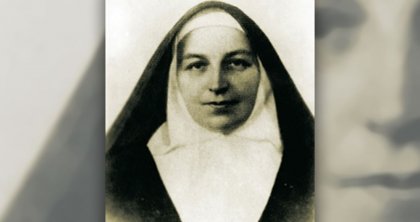
Janina Kierocińska was born on 14th of June 1885 in Wieluń (Poland) into a large family of deeply religious landowners. She was baptized on June 21, 1885. Already on the day of her First Communion, June 9, 1895 (on the same day Therese of the Child Jesus offered herself as a sacrificial victim to the merciful Love of God), she felt a lively intimacy with Jesus in the Eucharist and wished to dedicate herself completely to God. Her vocation encountered difficulties on the part of her parents and especially from father. From her youth she became acquainted with the works of Saint Teresa of Jesus, which had a strong influence on her spiritual life. In the family environment she led a life of deep prayer, sacrifice and love of neighbour.
From 1909 she was under the spiritual guidance of the Servant of God, Father Anselm Gądek OCD (1884-1969). On 11th of May 1911, she entered the Third Order of Discalced Carmelites in Krakow and on 6th of October 1914 she made her profession, taking the name Teresa. When Father Anselm, as Provincial of the Polish province, founded on December 31, 1921, the contemplative-active Congregation of the Carmelite Sisters of the Child Jesus, he appointed Janina Kierocińska as the first superior of the new Congregation. Since then, as Mother Teresa of St. Joseph, together with the sisters of the new community, she began to serve God and the people in the poorest neighbourhood of Sosnowiec. During Father Anselm's stay in Rome (1925-1947), Mother Teresa for 21 years, that is, until her death, directed the life of the Congregation according to the constitution, written by him and approved in 1933 by the Bishop of Częstochowa.
The Servant of God (Janina) formed the sisters in the charism given by Fr. Founder in spiritual childhood and guided the works of the apostolate and mercy among the poor. During World War II she showed heroic courage. She protected in the convent the girls destined for deportation to Germany, helped the soldiers of the «Armia Krajowa», organized aid for refugees, cooking for the poor and the orphanage, dedicating herself to clandestine teaching of the children and youth. During the German occupation, she risked her life saving the Jews and after her death in 1992, she was decorated with the Righteous Among the Nations medal awarded by the Yad Vashem Institute of National Memory in Jerusalem. After the war, Mother Teresa, together with the sisters, took part in the new tasks of the Church in Poland. The sisters took care of catechesis in schools, ran a kindergarten and dedicated themselves to charitable work.
The magnanimous love she felt for every person rose from her profound unity with God. Throughout her life she cultivated in herself the spirit of prayer and sacrifice precisely for the sisters. Her pathway to holiness consisted of a total trust in God and dedication to neighbour. She was distinguished in a particular way by her devotion to the Child Jesus, the Holy Eucharist, the Most Sacred Face of Jesus, Our Lady of Mt Carmel and Saint Joseph.
She died, reputed for her holiness, on 12th of July 1946 in Sosnowiec. Currently her remains lie in the church of the Most Holy Face of Jesus in Sosnowiec. The cause of beatification of Mother Teresa of St. Joseph was begun on September 14, 1983 and was conducted in the diocese of Częstochowa in the years 1983-1988.
The Decree on Heroic Virtues was promulgated by Pope Francis on May 3, 2013.
Procedure - Maria Teresa di San Giuseppe (Kierocińska)
1. The canonical norms concerning the procedure to be followed in the Causes of Saints are stated in the Apostolic Constitution Divinus Perfectionis Magister promulgated by John Paul II on 25 January 1983 (AAS LXXV, 1983, 349-355).
2. To initiate a Cause it is necessary that at least five years pass after the death of the candidate. This is to allow for greater balance and objectivity in the evaluation of the case and to allow the emotions of the moment to decant. There must be a clear conviction among people about his/her sanctity (fama sanctitas) and about the efficacy of his/her intercession with the Lord (fama signorum).
Last News

Servant of God Maria Angelica of the Eucharist
June 25, 2026

Venerable Jean-Thierry of the Child Jesus and the …
June 17, 2026

Venerable Maria Eletta di Gesù
June 17, 2026

Venerable Maria Teresa of the Most Holy Trinity (Y…
June 17, 2026

Blessed Anna of Saint Bartholomew
June 10, 2026

Martyrs of Santander
May 27, 2026